What Does a Year-Round Lawn Maintenance Program Look Like in Boynton Beach?
TL;DR
- Lawn maintenance in Boynton Beach requires a program built around South Florida's two-season climate (wet season from May through October, dry season from November through April) with mowing, fertilization, irrigation, and pest management adjusted to each.
- St. Augustine grass, the most common turf in Palm Beach County, requires specific protocols that a standard mow-and-go service rarely delivers.
- A properly structured program accounts for Florida's fertilizer blackout periods, seasonal chinch bug and fungal pressure, and species-specific mowing heights year-round.
There's a particular kind of frustration that Palm Beach County homeowners know well. The lawn looks reasonable in January, then by July it's patchy, yellowing, and nobody can quite explain why. The service shows up on the same schedule it always has. The irrigation is running. But something is wrong, and the diagnosis is usually the same: the program never changed with the season.
Lawn maintenance in Boynton Beach isn't a fixed routine. South Florida's climate runs on two distinct seasons that put different demands on turf, and the properties that stay in good condition year after year are managed with programs that adapt to both. This guide covers what that actually looks like for St. Augustine grass, Zoysia, and Bermuda turf across Palm Beach County and what separates a real maintenance program from a crew that just keeps showing up.
What Does a Professional Lawn Maintenance Program Actually Include?
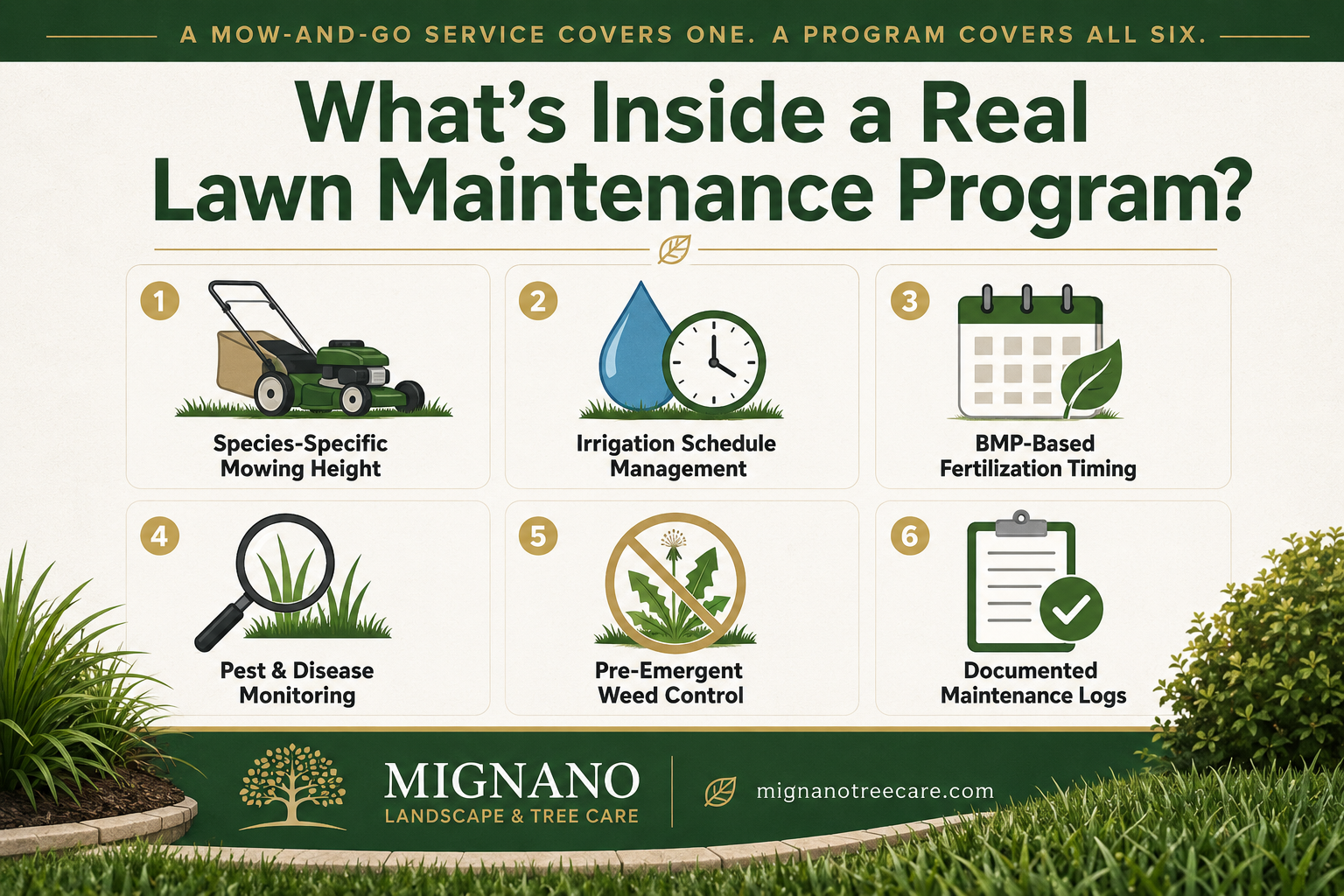
A professional lawn maintenance program covers mowing at the correct height for the turf species, edging, irrigation schedule management, fertilization timed to Florida's seasonal restrictions, pre-emergent weed control, and active monitoring for the pest and disease pressures specific to South Florida turf.
That list may sound straightforward, but the execution is where programs diverge. A mow-and-go service handles the first item. A program handles all of them, adjusts timing based on what's actually happening with the turf, and tracks conditions between visits rather than resetting on every arrival.
What separates a program from a mow-and-go service
The difference isn't just the number of services on an invoice. A mow-and-go operation runs a fixed schedule, mows at whatever height the mower is set to, and moves on. A properly structured program means someone with genuine turf knowledge is evaluating the lawn on each visit, looking at color, density, thatch depth, soil moisture, and any early signs of pest or disease pressure. The response to what they find changes what happens next, not what was scheduled three months ago.
How Horticultural BMPs apply to lawn care
Florida's Horticultural Best Management Practices aren't a marketing term. They're a documented framework developed to protect South Florida's waterways and ecosystems while maintaining healthy turf. In practice, BMPs govern fertilization timing, pesticide application thresholds, irrigation calibration, and mowing protocols. A program built around BMPs produces healthier turf with less input waste and keeps properties in compliance with local ordinances that many homeowners don't know exist.
Lawn maintenance programs in Boynton Beach built on this framework produce measurably different results over a full year.
How Does South Florida's Climate Affect Lawn Care Scheduling?
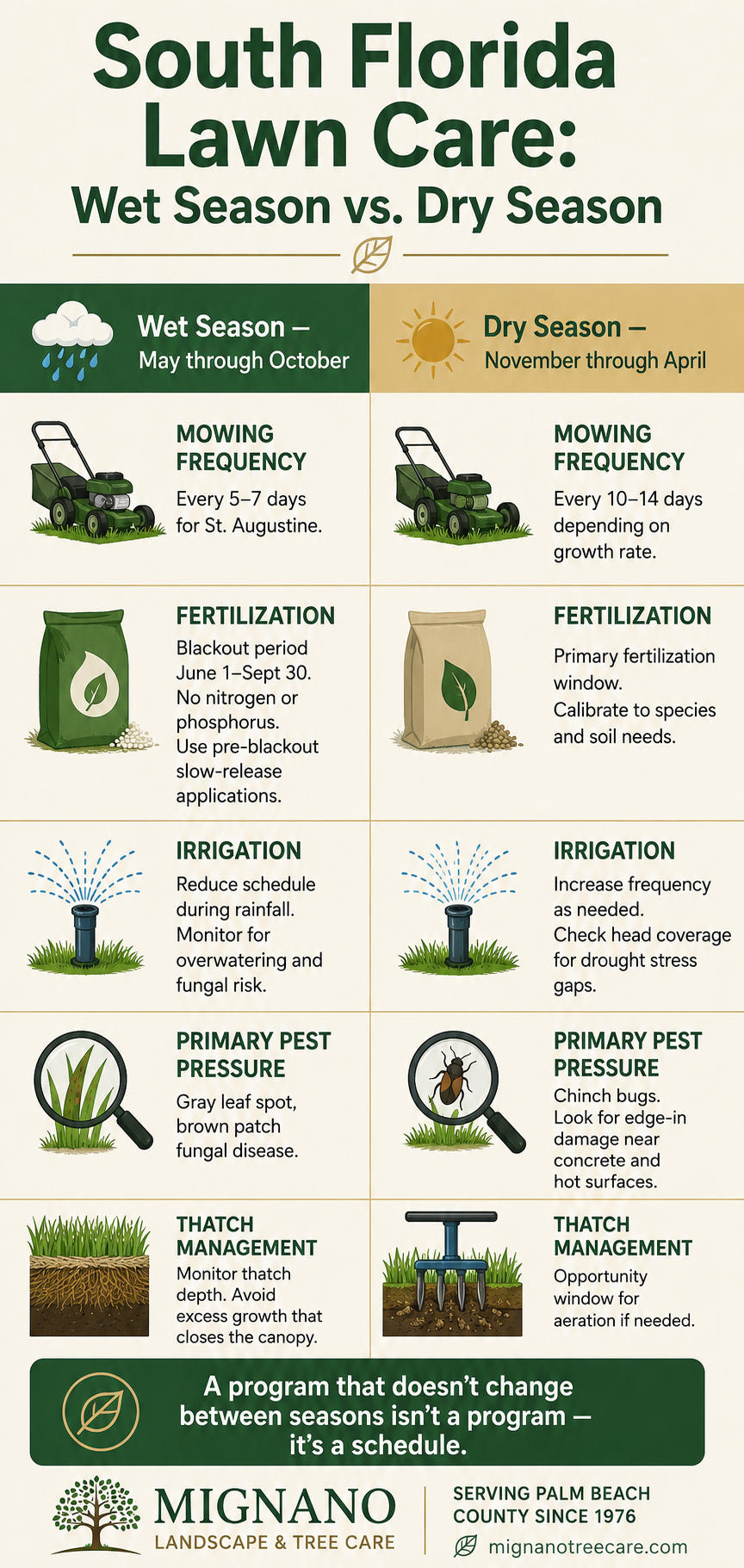
Boynton Beach's wet season brings rapid growth, fungal pressure, and waterlogging risk. Dry season brings drought stress, irrigation dependency, and chinch bug vulnerability. A proper program shifts protocols between seasons rather than holding a fixed year-round schedule.
This is the central concept that most homeowners and many service providers underestimate. Palm Beach County turf doesn't just grow more in summer. It faces entirely different threats, requires different mowing frequency, and responds to inputs differently depending on the time of year.
Wet season lawn care priorities (May through October)
Growth rates accelerate significantly during South Florida's rainy season. St. Augustine grass may need mowing every five to seven days rather than the every-ten-to-fourteen-day schedule that worked in February. Mowing too infrequently lets the canopy close, increasing humidity at the soil surface and creating conditions where fungal disease establishes quickly.
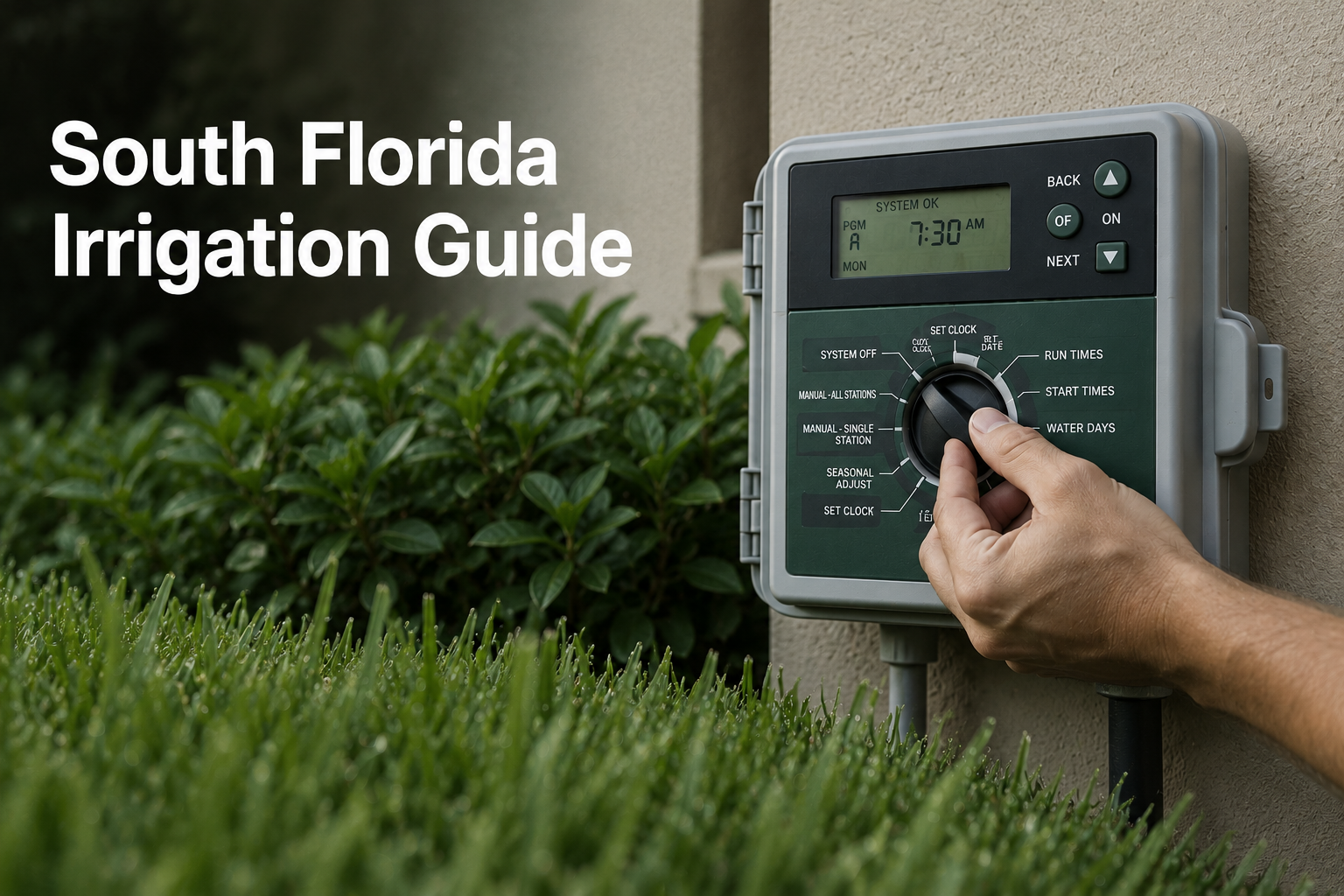
Irrigation scheduling requires real adjustment during wet season. Leaving irrigation systems running on a dry-season schedule overwaters turf during periods of daily rainfall, and standing water combined with heat accelerates fungal stress.
Dry season lawn care priorities (November through April)
Dry season shifts the primary pressure to drought stress and chinch bugs. Chinch bugs thrive in sunny, dry conditions and attack St. Augustine turf from the edges of lawns inward, often starting near concrete or asphalt where heat concentrates. Their damage pattern gets misread as drought stress constantly, which leads to increased irrigation when what's actually needed is treatment.
Why Is St. Augustine Grass Turning Brown and What Fixes It?
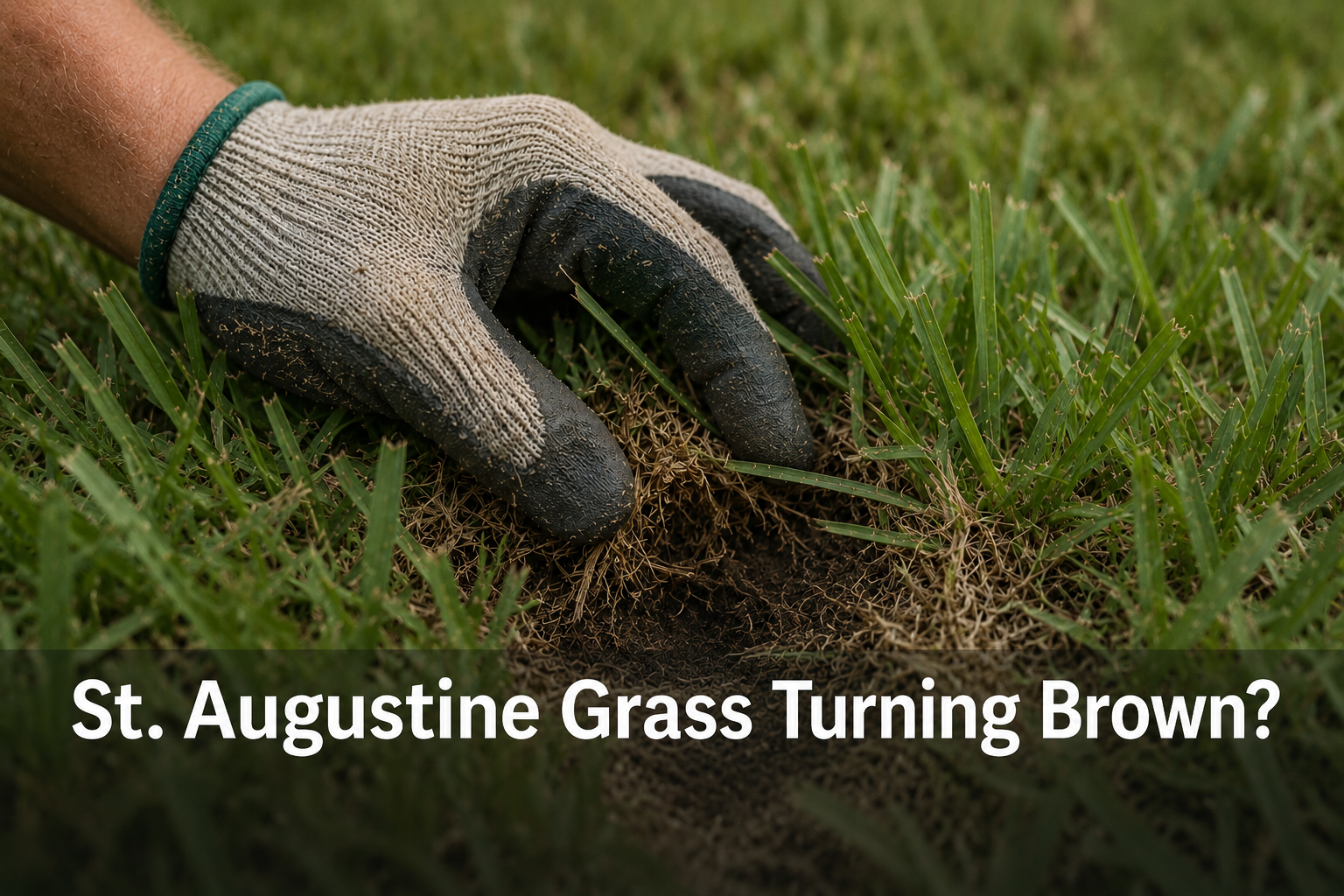
Brown patches in St. Augustine grass in South Florida are most commonly caused by chinch bug damage, fungal disease (gray leaf spot or brown patch), or irrigation failure. Heat alone rarely causes uniform browning, and misdiagnosis leads to treatments that make the problem worse.
This is one of the most consistent patterns in lawn care across Palm Beach County. A homeowner notices brown areas, increases irrigation, and the problem expands. Or they apply a fungicide to what's actually chinch bug damage and lose several weeks while the infestation continues. The visual cues are different enough to distinguish with proper training, but only if you're looking for them.
How to identify chinch bug damage vs. fungal stress
Chinch bug damage typically starts in irregular patterns near sunny edges of the lawn, often along driveways, sidewalks, or fence lines where heat concentrates. Pull back the turf at the edge of a brown area and look at the soil surface and thatch layer. Chinch bugs are small (about 1/8 inch), fast-moving, and visible in active infestations.
Gray leaf spot, one of the most common fungal issues in South Florida St. Augustine lawns, shows up as small lesions on individual blades with a tan or brown center and a darker border. The damage pattern is more diffuse than chinch bug injury and often correlates with recent rainfall and periods of high humidity.
How irrigation gaps cause drought stress patterns
Irrigation head coverage gaps or failed zones create drought stress in localized areas that can look similar to fungal damage. The fastest diagnostic step is simply checking each irrigation zone for coverage. A blocked or broken head explains a lot of browning in South Florida lawns that gets attributed to something else. For anyone managing why St. Augustine grass turns brown in summer, proper diagnosis before treatment is the first step every time.
What Fertilization Schedule Does South Florida Turf Actually Need?
Florida's fertilizer blackout periods restrict nitrogen and phosphorus applications between June 1 and September 30 in most Palm Beach County municipalities. A BMP-based program works within these windows and uses slow-release formulations to maintain turf health without regulatory violations.
The blackout period exists for good reason. Nutrient runoff during South Florida's heavy wet-season rainfall contributes to waterway degradation across the region. Properly timed fertilization means applying the right inputs at the right time, not circumventing the restriction, but building a program that accounts for it.
Florida fertilizer blackout period explained
Most municipalities in Palm Beach County follow the June 1 through September 30 restriction on nitrogen and phosphorus applications. Some local ordinances extend this or add restrictions beyond the state baseline. Applications made shortly before the blackout period begins, using slow-release nitrogen formulations, provide residual turf support through part of wet season without requiring applications during the restriction window.
How Horticultural BMPs guide fertilization timing
A BMP-based approach doesn't just stay legal. It produces better turf health over time. Slow-release nitrogen applied at calibrated rates feeds turf more evenly than high-rate soluble applications, reduces flush growth that creates mowing problems, and puts less stress on root systems. The season-appropriate formulation matters as much as the timing. Fertilization is one piece of a complete lawn program, and getting it right means understanding how micronutrient applications during blackout periods can support turf health within the regulatory framework.
How Often Should a Boynton Beach Lawn Be Mowed?
During wet season, St. Augustine grass in Boynton Beach may need mowing every five to seven days to maintain proper height. Scalping or mowing too low stresses the turf and creates conditions for fungal invasion and weed pressure.
Mowing frequency is the variable most homeowners accept as fixed when it's actually one of the most important adjustments a program makes between seasons.
Correct mowing height for St. Augustine, Zoysia, and Bermuda
St. Augustine grass should be maintained at three to four inches in most South Florida conditions. Cutting below three inches removes too much leaf blade at once, weakens the plant's ability to photosynthesize, and opens the turf to weed establishment. Zoysia tolerates shorter cutting, typically one to two and a half inches depending on the variety. Bermuda, less common on residential properties in Palm Beach County but present on some commercial sites, is typically maintained between one and two inches with specialized mowing equipment.
Why mowing frequency matters more than people expect
The one-third rule applies here: no more than one-third of the blade should be removed in a single mowing pass. During rapid wet-season growth, following that rule means mowing more frequently. Waiting two weeks and then cutting heavily triggers stress responses in the plant, opens it to disease, and thins the canopy. Consistent, properly timed mowing is part of what keeps Palm Beach County turf dense enough to crowd out weeds naturally.
What Should Commercial and HOA Properties Look for in a Lawn Care Program?
Commercial and HOA properties require documented maintenance schedules, consistent crew assignment, and a provider with experience managing multiple turf zones across a single property. Aesthetic consistency and reliability are non-negotiable at that scale.
A residential lawn program requires competence. A commercial or HOA program requires competence plus systems, the ability to maintain consistent appearance across large or varied turf zones, communicate proactively when conditions change, and document what was done and when.
What HOA landscape contracts typically require
HOA clients in Palm Beach County's coastal communities typically require defined service windows, detailed maintenance logs, a named point of contact, and clear protocols for storm-event response. A provider managing HOA accounts needs both the technical capability and the administrative consistency to meet those expectations without prompting. Maintenance gaps on HOA properties generate resident complaints and board pressure, which is why long-term relationships with a single provider matter more at this scale than they do for individual homeowners.
How Mignano manages commercial lawn programs across Palm Beach County
We've been managing residential and commercial lawn programs across Boynton Beach, Boca Raton, Delray Beach, Gulf Stream, and the surrounding communities for decades. The approach at every scale is the same: a program built around what the specific turf needs, adjusted as conditions change, and maintained by a team that knows the property.
Frequently Asked Questions About Lawn Maintenance in Boynton Beach
How often should a lawn be mowed in Boynton Beach?
During wet season (May through October), St. Augustine grass in Boynton Beach typically needs mowing every five to seven days. During dry season, the interval extends depending on growth rate and irrigation schedule. Mowing at the wrong height or too infrequently creates conditions for fungal disease and weed pressure in South Florida's humid climate.
Why is my St. Augustine grass turning brown in summer?
Brown patches in St. Augustine turf are most commonly caused by chinch bugs, fungal stress (gray leaf spot, brown patch), or irrigation failure, not heat alone. Each cause has a different visual pattern and requires a different treatment. Misdiagnosis is common and leads to treatments that don't address the actual problem.
What is the fertilizer blackout period in Palm Beach County?
Most municipalities in Palm Beach County prohibit the application of nitrogen and phosphorus fertilizers between June 1 and September 30 to reduce nutrient runoff during the wet season. A Horticultural BMP-based lawn program is designed around these restrictions, using pre-blackout applications and slow-release formulations.
How do I know if my lawn care service is following Horticultural BMPs?
Ask directly. A provider following Florida's Horticultural Best Management Practices will be able to explain their fertilization timing relative to blackout periods, their integrated pest management approach, and how they calibrate irrigation to seasonal rainfall. If they can't answer those questions, the program isn't BMP-based.
Joe Mignano's Perspective
"South Florida turf is not forgiving of a set-it-and-forget-it approach. The same property in Boynton Beach needs a completely different program in July than it does in February, with different mowing frequency, different irrigation schedule, and different pest pressure to watch for. We've been managing lawns in Palm Beach County long enough to know that the properties that stay in the best condition year after year are the ones where the program actually changes with the season, not the ones where a truck shows up on the same schedule regardless of what the turf is doing."
— Joe Mignano, President, Mignano Landscape & Tree Care; FNGLA Certified Horticulture Professional
Ready to Build a Lawn Program That Works Year-Round?
Wet season is when most South Florida lawns lose ground. Fungal pressure builds, rapid growth creates mowing problems, and irrigation systems that work fine in January are suddenly running too much or not enough. The programs that handle wet season well are the ones built for it, with the right mowing frequency, pre-blackout fertilization applied correctly, and a team that knows how to read the turf rather than just service it.
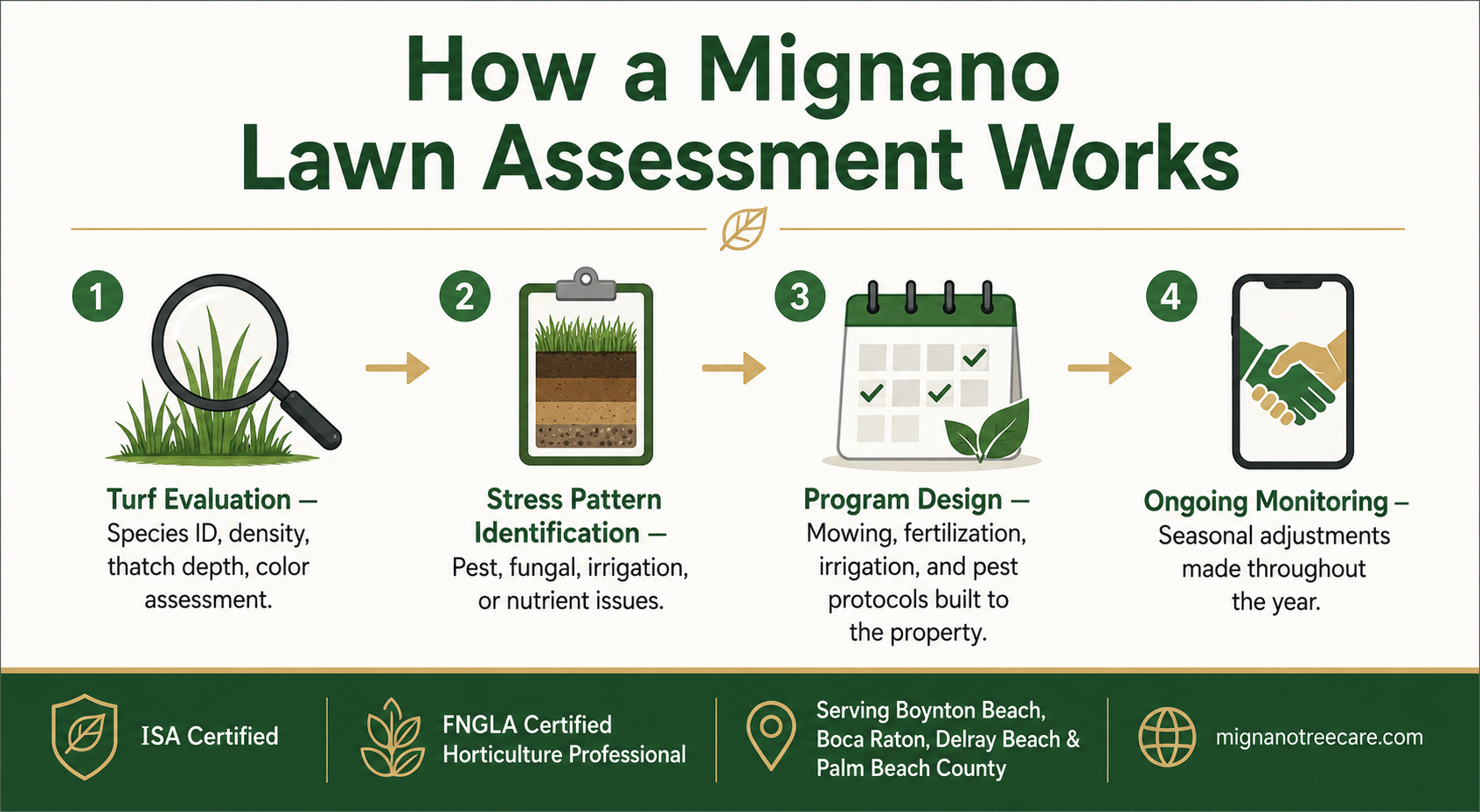
We offer lawn program assessments across Boynton Beach, Delray Beach, Boca Raton, West Palm Beach, Gulf Stream, Manalapan, and Ocean Ridge. Our team evaluates the current state of the turf, identifies existing stress patterns, and recommends a program built around the property's specific species, soil, and irrigation setup.
Mignano Landscape & Tree Care has served Palm Beach County since 1976. Joe Mignano is an FNGLA Certified Horticulture Professional. All programs are built on Horticultural Best Management Practices. Our ISA-certified team handles both residential and commercial accounts.
Recent Posts